Garage Door Opener Repair & Service
How Many Years Should a Garage Door Opener Last?
Most garage door openers last 10 to 15 years. See drive-type variance, end-of-life signs, and why aging openers fail modern safety standards.
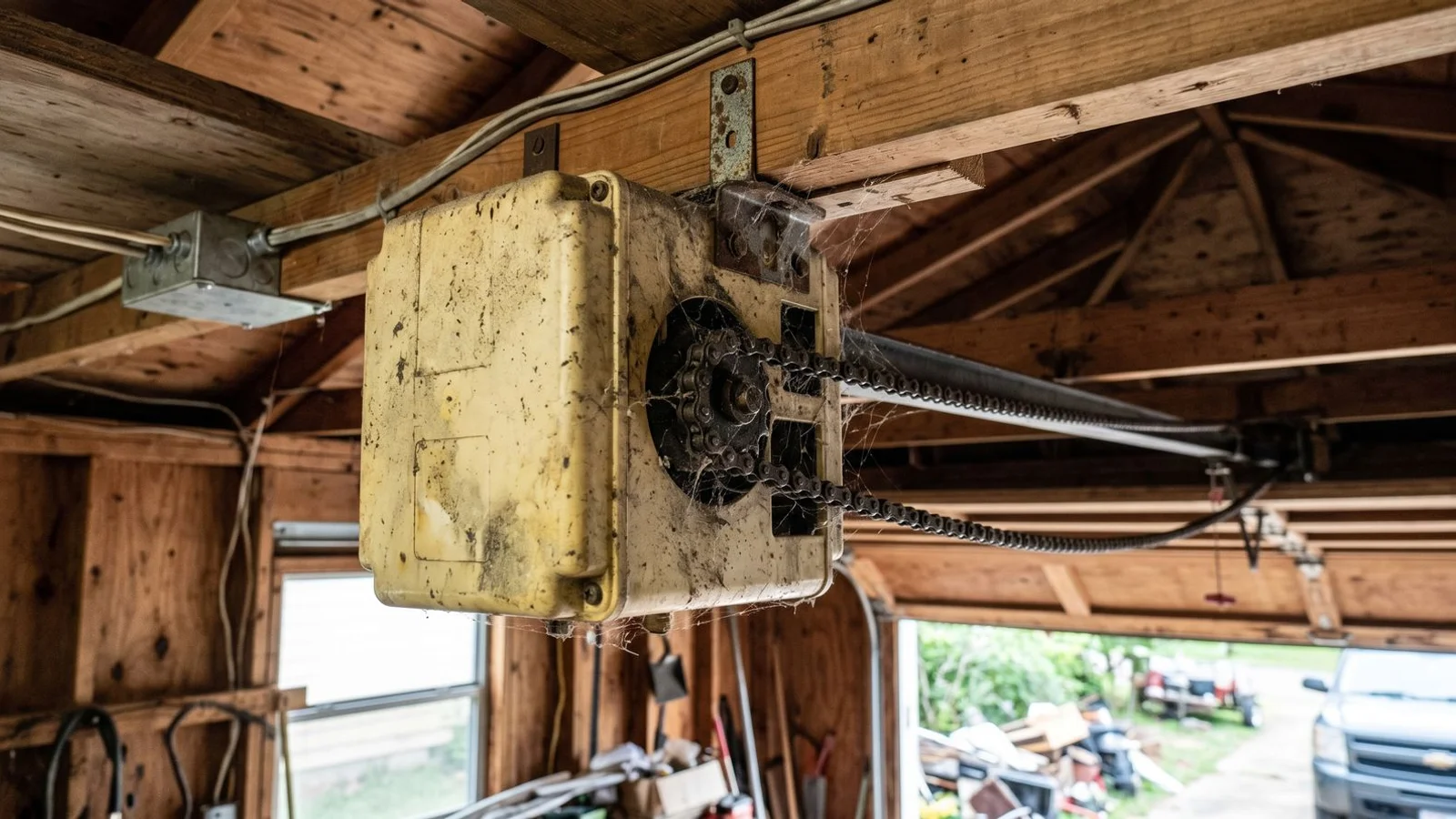
We find that most homeowners start asking how long do garage door openers last right around the decade mark.
The standard opener lifespan usually falls between 10 and 15 years for residential units.
Our local repair technicians see a lot of variation based on drive type and daily cycle counts.
A busy family cycling their door six times a day will wear out a standard motor much faster than a single commuter.
We put together this guide to help you decide exactly when to repair or replace your system.
Examining the data for each common system reveals clear, practical guidelines for your home.
Lifespan by Drive Type
You can expect your opener lifespan to average 10 to 18 years depending entirely on the mechanical drive system it uses.
We recommend checking the drive type first, as this dictates both longevity and daily maintenance needs.
Every standard residential operator is rated for roughly 10,000 to 15,000 full cycles.
Our technicians track performance across all major brands to see how they hold up in actual United States garages.
The following breakdown shows exactly what you should expect from each category.
| Drive Type | Average Lifespan | Typical Noise Level | Common US Models |
|---|---|---|---|
| Chain Drive | 10 to 13 years | High (Metal-on-metal) | LiftMaster 84602 |
| Belt Drive | 12 to 15 years | Very Quiet | Chamberlain B6765T |
| Screw Drive | 10 to 14 years | Moderate | Genie MachForce |
| Jackshaft (Wall-Mount) | 12 to 18 years | Ultra-Quiet | LiftMaster 87504-267 |
Chain Drive Systems
These traditional units typically last 10 to 13 years before needing major repairs.
Our crews appreciate chain drives for their raw mechanical durability, as the steel chain itself rarely snaps.
The higher operating force puts more strain on the internal plastic gear and sprocket assembly.
Belt Drive Systems
Belt-driven models usually survive 12 to 15 years and provide significantly quieter operation.
We install units like the Chamberlain B6765T specifically for homeowners with bedrooms positioned right above the garage.
The steel-reinforced rubber belt eventually stretches and might need replacing around year eight or ten.
Screw Drive Systems
A standard screw drive system offers a solid 10 to 14 years of reliable service in stable, mild climates.
Our service logs show these units struggle and wear out faster in regions with extreme seasonal temperature swings.
The threaded steel rod requires consistent lubrication twice a year to prevent the plastic carriage teeth from stripping.
Jackshaft (Wall-Mount) Systems
These premium side-mounted operators often outlast ceiling-mounted alternatives with a 12 to 18-year track record.
We highly recommend the LiftMaster 87504-267 for garages with high ceilings or oversized custom doors.
Connecting directly to the torsion bar eliminates the need for a rail system entirely.
End-of-Life Signs
The most obvious warning that you need to evaluate when to replace garage door opener systems is intermittent response to your remote.
We tell homeowners to listen closely, as a failing unit always gives auditory clues before a total breakdown.
A sudden mechanical failure can trap your car inside at the worst possible time.
Our repair teams look for these specific symptoms during routine inspections.
Spotting two or more of these issues simultaneously usually means a hard failure is imminent.
- Failing internal gears: A loud grinding noise or a humming sound without any door movement usually points to stripped plastic gears.
- Intermittent operation: The door works flawlessly on Monday but ignores commands on Tuesday.
- Electrical gremlins: Dim, flickering courtesy lights or strange beep codes that do not match the manufacturer manual indicate a failing logic board.
- Delayed response times: Pressing the wall button results in a two-second delay before the motor finally engages.
- Physical degradation: Discolored, yellowed plastic housing or loose mounting brackets point to a unit suffering from a decade of accumulated vibration.
Why Old Openers May Fail Modern Safety Standards
An outdated unit poses significant safety risks because it lacks modern entrapment protections and secure radio frequencies.
We prioritize replacing old motors that cannot comply with current Underwriters Laboratories guidelines.
The federal government mandated strict changes through the UL 325 safety standard back in 1993.
The Pre-1993 Sensor Mandate
Any motor installed before 1993 lacks the required photo-eye safety sensors at the base of the door tracks.
Our technicians will immediately flag these systems because they represent a massive liability for families.
Current federal codes dictate that an automatic door must reverse direction instantly if an object breaks the invisible infrared beam.
Early-2000s Security Flaws
Openers from the early 2000s rely on fixed-code radio receivers that transmit the exact same signal every time you press the remote.
We constantly see these older systems compromised by basic signal-capture devices used by local thieves.
Upgrading to a modern unit provides Security+ 2.0 rolling code technology, which generates a brand new access code out of billions of possibilities after every single use.
Pre-Smart-Home Protocol Limits
Many reliable older models simply do not contain the internal hardware required to communicate with modern Wi-Fi networks.
Our installers note that recent Security+ 3.0 updates actively block many third-party aftermarket accessories.
Swapping out the entire head unit is often the only viable path forward if controlling the garage from your phone is a priority.
When Repair Stops Making Sense
The smartest financial move is to replace the unit if a single repair estimate exceeds 50 percent of the cost of a brand new installation.
We use this 50 percent rule to help customers avoid sinking cash into a failing, ten-year-old motor.
A modern, professionally installed belt-drive unit typically runs between $550 and $850 depending on your exact location in the United States.
Our pricing guidelines make the repair versus replacement decision much clearer.
Review this quick breakdown before authorizing a costly repair.
| Repair Estimate | Opener Age | The Best Financial Decision |
|---|---|---|
| Under $200 | Less than 12 years old | Repair. The logic board and motor still have plenty of life. |
| $200 to $350 | 8 to 11 years old | Marginal. Repair only if you love the current unit. |
| $200 to $350 | 12+ years old | Replace. You will likely face another breakdown soon. |
| Over $350 | 10+ years old | Replace. Put that money toward a modern, quiet system. |
Smart-Home Upgrade Trigger
Adding voice control through Alexa or Google Home fundamentally changes the math on keeping an older opener.
We find that many homeowners choose a full replacement just to gain native smartphone monitoring capabilities.
A smart setup allows you to grant temporary access to delivery drivers or check the door status from your bed.
- Existing opener accepts retrofit: Adding a basic smart hub costs roughly $50 to $100 and requires no major mechanical changes.
- Existing opener blocks retrofit: Upgrading the whole unit is mandatory if your current logic board rejects the retrofit protocol.
Our team can confirm retrofit compatibility directly on your driveway during a quick diagnostic visit.
Most LiftMaster, Chamberlain, and Genie units manufactured in the last ten years will accept some form of basic smart-home gateway.
We always warn clients that recent platform changes now actively restrict certain third-party voice assistant integrations.
Checking the exact model number prevents you from buying an incompatible accessory.
Proactive Replacement Strategy
Swapping out a struggling twelve-year-old motor before it completely snaps is the most cost-effective strategy.
We advise taking action early because emergency, after-hours repair visits always carry premium service fees.
A planned installation allows you to compare models, secure fair pricing, and schedule the work at your convenience.
Our clients who wait for a catastrophic breakdown often find themselves trapped in the garage right before a major appointment.
The actual hardware costs the exact same whether you buy it today or during a midnight emergency.
We highly recommend reviewing your options the moment you notice those early warning noises.
A failing system will only get louder and more erratic over time.
- Avoiding emergency fees: Scheduled installations skip the rush charges associated with weekend or night service calls.
- Eliminating the limp-along phase: You stop dealing with the daily frustration of a door that only closes half the time.
- Securing your property: A broken door left open overnight is an open invitation for pests and property theft.
Our technicians are ready to evaluate your current setup and measure it against the 15-year average lifespan.
See our repair-vs-replace decision guide for the full framework on making the best long-term choice.
We gladly offer free on-site assessments if you call (479) 469-8829 to book an appointment.
Upgrading your hardware today ensures a quiet, reliable departure every single morning.
Frequently Asked Questions
Should I replace my opener before it fully fails?
If it's 12+ years old and showing symptoms, proactive replacement avoids being stuck. Newer openers add safety and smart features.
Which drive type lasts longest?
Belt drives typically outlast chain drives in noise and smoothness. Both can last 12 to 15 years with maintenance.
Can I just replace the motor and keep my rail?
Sometimes — if the rail is the same brand and length, the motor head can be swapped. We usually replace the full unit because the price difference is small.