Emergency Garage Door Repair
Car Trapped in Garage? Here's What to Do — Right Now
Step-by-step instructions for a car trapped by a broken garage door spring. What to do safely while you wait for an emergency tech.
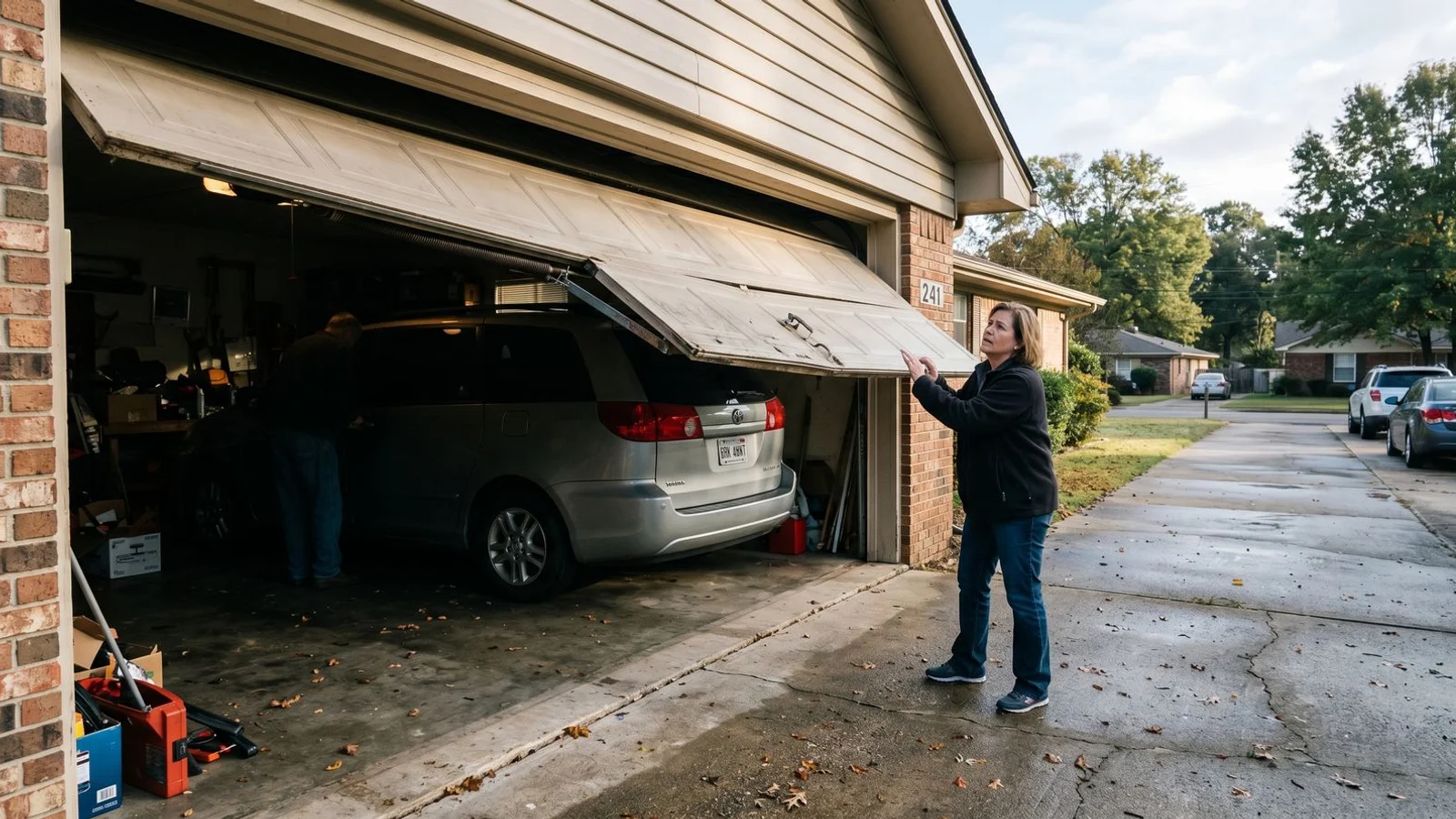
We know how one mechanical failure can instantly derail an entire morning.
A standard steel two-car garage door in the US weighs between 150 and 250 pounds. Dealing with a car trapped in garage broken spring situation turns that heavy lifting into a major hazard.
Our technicians see this panic regularly when a stuck vehicle wrecks a daily schedule. Let’s look at the hardware facts and explore practical ways to respond safely. The following guide breaks down the exact steps to protect your property before help arrives.
Step 1: Stop and Assess
We strongly advise against pressing the opener button repeatedly. Each attempt puts severe stress on a system that has already failed.
Visual clues will tell you exactly what went wrong. Our first troubleshooting step is always to look at the balance of the door.
You might notice one side hanging much lower than the other. A loud bang overnight is a classic warning sign when a garage door wont open with car inside. We usually trace these symptoms back to a structural component failure.
The massive panels simply become too heavy for the electric opener to lift alone. This quick comparison chart helps identify which type of hardware just snapped on your system.
| Feature | Torsion Spring | Extension Spring |
|---|---|---|
| Location | Mounted on a metal tube directly above the closed door. | Running vertically along the horizontal side tracks. |
| Breakage Sign | A clear two-inch gap appears in the steel coils. | The hardware looks stretched out or hangs loosely. |
| Function | Twists to create torque and lift the heavy door. | Stretches and contracts to counter the structural weight. |
We want you to identify these parts visually without actually touching them.
Any visible gap in the torsion coil means the system is completely compromised. A failed structural cable produces the exact same dangerous imbalance.
Step 2: Do NOT Try to Force the Door
Our biggest warning here is to avoid relying on the automatic opener. Residential motors are only designed to lift five to ten pounds of a properly balanced door.
Hitting the button forces the motor to essentially dead-lift hundreds of pounds of dead weight.
We have seen this common mistake burn out countless opener systems. Replacing a burned-out garage door motor in the US currently averages around $600. A simple spring fix quickly turns into a massive replacement bill if you force it.
We also need to address the danger of driving under a compromised structure. Do not attempt to drive out through a partially open or propped-up entryway.
The heavy panels can drop suddenly onto your vehicle and cause devastating damage.
Step 3: Identify the Manual Release Cord
Our modern opener systems all feature a distinct emergency release mechanism. You will find a red emergency release cord hanging from the trolley along the ceiling rail.
It typically features a brightly colored plastic handle attached to a short rope. We must emphasize a critical safety rule before you touch that handle.
You should not pull the mechanism right away. Read the next step carefully to prevent a sudden structural collapse.
Step 4: Check Whether It’s Safe to Pull the Release
Our goal is to ensure you fully understand the risks of manual operation. The manual release cord simply disconnects the carriage from the opener track so you can lift the door by hand.
This action is only safe if the tensioned springs are completely intact. We have to warn you about the severe physics of a broken spring scenario. Pulling the release on a broken system means gravity takes over instantly.
The heavy structure will drop forcefully onto a car or foot in its path.
How to Perform a Safe Manual Check
Our technicians recommend a very specific process for checking the hardware first. Stand inside the garage and verify the door is resting fully closed against the floor.
Look closely for a visible spring break or a lopsided stance before proceeding. We strongly advise you to back away if you spot those clear warning signs.
Do not pull the release cord under any circumstances if the springs look compromised. The safest option is to call for professional emergency assistance immediately.
Our advice changes slightly if the entryway is fully closed and the springs look perfect. You can pull the release gently and attempt to lift the door manually.
Stop immediately and let it close if the panels feel like a heavy dead lift. We know a heavy feel indicates a subtle balance problem rather than an electrical malfunction.
A truly balanced structure should be exceptionally easy to lift with just one hand. The heavy sensation means the system is completely unsafe for manual operation.
Step 5: Call for Emergency Repair
Our dispatchers are ready to handle these urgent scenarios at (479) 469-8829. You need to provide a few specific details to help the technician prepare for the job.
Gather this basic information before you pick up the phone.
- Your exact property address.
- A description of what happened, such as a loud bang or sudden weight drop.
- Whether your car is genuinely trapped inside the bay.
- Whether anyone else in the house needs vehicle access today.
We always prioritize repair calls where a vehicle is genuinely stuck. Customers inside Fayetteville typically see an emergency technician arrive within 60 to 90 minutes. Residents in Springdale, Farmington, Rogers, and Bentonville usually receive same-day service even after standard business hours.
Step 6: While You Wait
Our primary concern is keeping you safely away from a high-tension hardware breakdown. You have a few safe alternatives to consider before risking a severe injury.
- Taking a second vehicle if one is parked outside.
- Calling a neighbor or partner for a ride to work.
- Using a ride-share service for the morning commute.
Avoiding the garage entirely is much better than attempting a dangerous DIY fix. We will gladly talk you through the situation if you absolutely must clear the bay.
Call the dispatch number with your plan so a professional can assess the stuck car emergency risk. There is sometimes a safe way to brace the opening if you have an intact extension spring with a functioning safety cable.
Our extensive experience shows that most broken spring scenarios offer no safe DIY exit. The severe risk of a sudden structural collapse is simply too high.
The heavy steel panels require specialized lifting equipment to move safely.
What the Tech Will Do on Arrival
We follow a strict safety protocol the moment a technician arrives on your property. The immediate priority is to secure the area and diagnose the root cause of the failure. The actual repair process moves very quickly once the door is fully stabilized.
- First, the technician confirms whether the issue is a broken spring, snapped cable, off-track roller, or a burned-out opener.
- Second, they safely brace the heavy panels to prevent any unexpected movement.
- Third, they remove the compromised hardware carefully.
Our standard arrival checklist ensures nothing gets missed during the repair. The broken components are quickly swapped out for high-quality replacement parts.
The technician then re-balances the door so it perfectly counters the panel weight. We finish the physical work by thoroughly testing the safety sensors and the opener function.
Most of these emergency repairs are fully completed in under an hour. You can read more about our rapid dispatch process on the emergency repair service page.
Our team also highly recommends reviewing the how to manually open guide for a deeper look at the safe release procedure. Call (479) 469-8829 right now if your vehicle is currently trapped. A professional emergency technician is ready to help restore your access safely.
Frequently Asked Questions
Can I just pull the red release cord and open it myself?
Only if the spring is intact. If a spring is broken, the door is too heavy and will drop dangerously. Call us first.
How fast can you get to me?
Inside Fayetteville, typically 60 to 90 minutes. Springdale and Rogers are usually same-day even after hours.
Can I drive my car out through the partially-open door?
No. Don't drive into a partially-open or unstable door. The door can drop on your vehicle and cause significant damage.