Emergency Garage Door Repair
How to Manually Open Your Garage Door (Safely)
Use the red emergency release cord safely, know when it's NOT safe (broken spring), and how to re-engage the opener after.
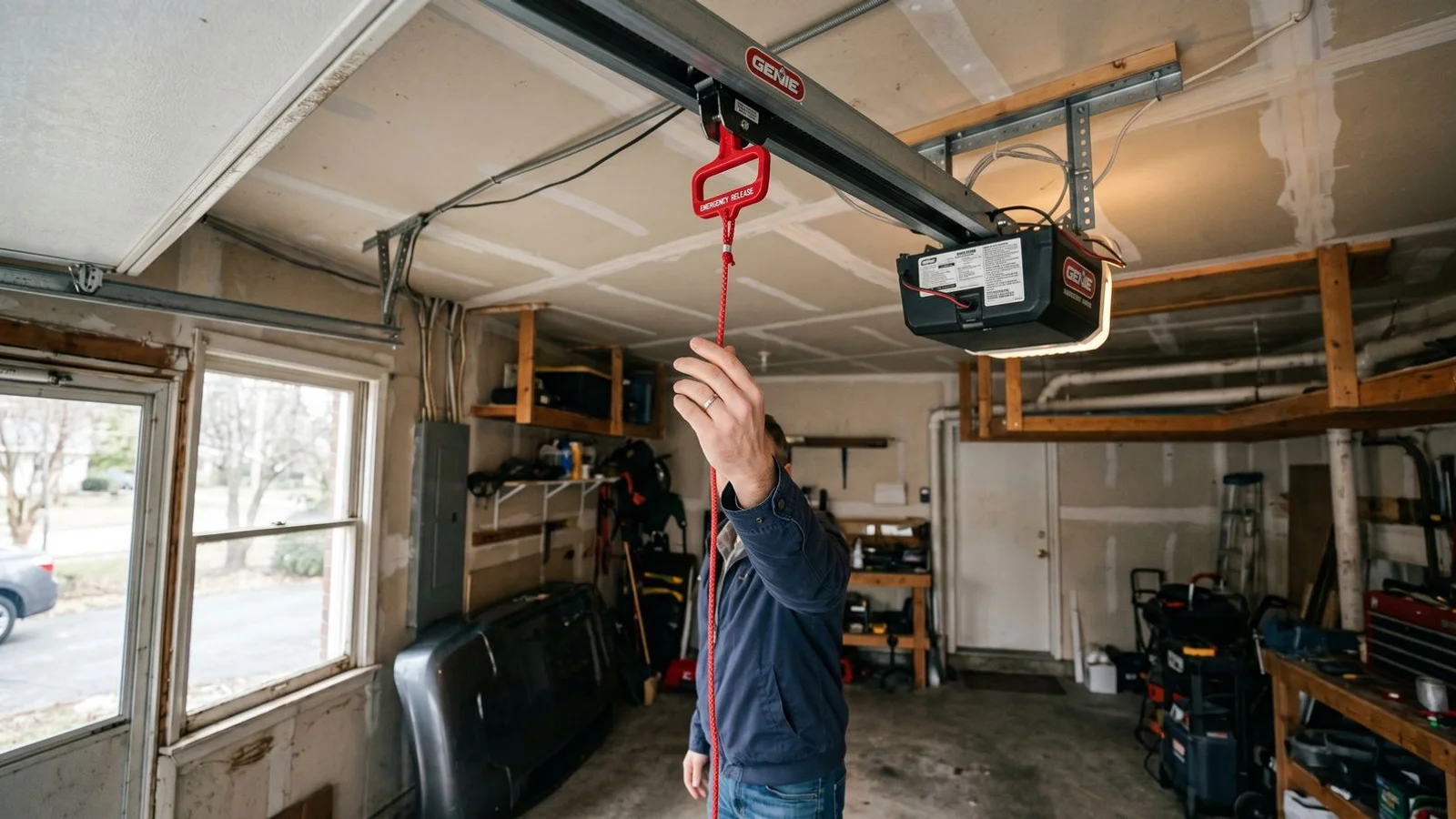
A failed motor can leave your car trapped inside. Our technicians get calls every week from homeowners staring at a stuck garage door. Learning how to manually open garage door systems safely is an essential skill.
We know exactly how frustrating this situation feels. The red emergency release cord on your opener provides a quick mechanical fix. Our goal today is to explain the proper use of this lifeline.
This mechanism disconnects the trolley.
We see property damage happen frequently when people use it incorrectly. A sudden drop easily crushes whatever sits below the panels.
We will break down exactly when it is safe to pull the handle. The following guide covers the safety data and the exact steps to get your car out without risk.
When the Release Cord IS Safe to Pull
You can safely pull the emergency release garage door cord only when the spring system is completely intact and the door rests fully closed on the ground. In these specific conditions, the torsion springs continue to hold the weight of the panels.
Our team sees standard torsion springs last for about 10,000 cycles before showing signs of severe wear. That lifespan translates to roughly seven to nine years of average daily operation.
We advise checking for three specific conditions before touching the handle. Pull the release cord when these factors line up:
- The opener is dead or malfunctioning: Power outages, a dead motor, or a failed logic board are common culprits.
- The springs are intact: Look for a continuous coil with no visible breaks.
- The door is fully closed: The bottom weather seal must sit completely flat against the concrete floor.
When the Release Cord Is NOT Safe to Pull
Do not pull the release cord if a spring is broken, a lifting cable has snapped, or the door is currently partially open. Disengaging the opener removes the only mechanism holding the door in place.
Our technicians constantly warn homeowners about the extreme weight of these structures. A typical residential two-car garage door weighs anywhere from 130 to 350 pounds.
We want you to understand the real danger of a sudden drop. According to 2024 National Electronic Injury Surveillance System (NEISS) data, over 2,200 Americans suffer crushing injuries each year from falling garage doors.
Do NOT pull the release cord when you notice any of these red flags:
- A spring is broken: Watch for a visible two-inch gap in the torsion coil above the door, or listen for a loud bang.
- A lifting cable is snapped: If the door hangs unevenly with one side noticeably lower, the cables are compromised.
- The door is partially open: A stuck opener might be the only thing preventing a 300-pound door from crashing down onto your car.
Our safety policy requires a professional inspection if you spot a broken torsion coil. When in doubt about the tension system, leave the cord alone and call an expert.
Step-by-Step: Pulling the Release
To pull the release, start with a completely closed door and yank the red handle straight down toward the floor until you hear a loud click. This action disconnects the trolley from the automated carriage.
We recommend following a strict sequence to prevent accidental injuries. The 2024 NEISS injury statistics report that over 7,550 Americans experience severe pinching injuries yearly from garage doors.
Our first rule is to keep your fingers far away from the panel hinges during this process. Here is the safest way to execute a manual open garage procedure:
- Make sure the door is fully closed. Use the wall button to get it fully down if it sits partially open.
- Locate the red cord. It hangs directly from the center trolley along the ceiling rail.
- Pull the cord straight down. Pull firmly toward the floor until you feel a click.
- Lift the door manually. Grab the bottom edge or the dedicated handle smoothly without jerking the panels.
- Open the door fully. Push it all the way up so the horizontal tracks support the full weight.
We suggest using a temporary clamp on the track if you need to leave the door open. This simple step prevents the door from unexpectedly rolling back down.
Step-by-Step: Re-Engaging the Opener
Reconnect the opener by fully closing the door manually, pulling the red cord toward the garage opening, and pressing your remote button. The carriage will automatically catch the trolley during its next cycle.
We find that many homeowners forget this crucial reset step after a power outage. Most modern systems from brands like Genie or LiftMaster use a spring-loaded trolley mechanism.
Our technicians use this standard procedure to put the system back into automatic mode. Follow these steps to restore regular function:
- Close the door fully by hand. Bring the panels gently down to the floor.
- Pull the red cord toward the front of the garage. Pull the handle toward the door opening until you feel another click.
- Press the wall button or remote. The opener motor will run through one complete cycle.
- Listen for the connection. The trolley will catch onto the rail-mounted carriage automatically with a distinct click.
- Verify operation. Run the door up and down once to ensure it moves normally.
We advise watching the trolley carefully during that first test cycle. The carriage should slide smoothly into place without grinding or hesitation.
Common Mistakes
The most frequent mistakes involve pulling the release cord while the door is moving or operating the system with a broken torsion spring. These errors cause immediate mechanical failure and pose severe safety hazards.
Our repair logs show these specific blunders account for a massive percentage of emergency service calls. According to NEISS injury reports, roughly 100 injuries occur annually just from individuals attempting to run beneath closing doors.
We constantly remind customers that a 350-pound panel system is unforgiving. Avoid these dangerous pitfalls:
| Mistake to Avoid | The Consequence | The Correct Action |
|---|---|---|
| Pulling release on a moving door | The sudden disconnect causes unpredictable drops and track damage. | Wait until the motor completely stops and the door is resting. |
| Ignoring a broken spring | The 130+ pound door crashes straight down, destroying property below. | Call a professional immediately for spring replacement. |
| Forgetting to re-engage | The opener cycles endlessly, but the door never moves from the ground. | Pull the cord toward the door to reset the trolley mechanism. |
| Slamming the door manually | Sectional hinges buckle and the bottom weather seal tears. | Guide the handle gently down until it touches the concrete. |
Our staff strongly recommends sharing these warnings with everyone in your household. A little education goes a long way in preventing emergency room visits.
Security While Manually Operating
Secure a manually operated door by attaching a heavy-duty C-clamp to the vertical track just above the top roller. Since the automatic opener is no longer locking the door down, this physical barrier prevents anyone from lifting it from the outside.
We tell clients that a disconnected garage door is an open invitation for intruders. Standard openers act as a deadbolt, but pulling the emergency cord removes that protection completely.
Here are the most effective ways to secure your garage:
- Use a Heavy-Duty C-Clamp: Tighten a four-inch clamp directly onto the metal track above the highest wheel to block the roller.
- Engage Built-in Slide Locks: Slide the metal locking bar through the corresponding square slot in the vertical track if your door includes one.
- Install a Track Stopper: For longer power outages, mount a mechanical track stopper to hold the panel firmly in place.
We consider the clamp or slide lock fine for a few hours while waiting for power to return. For overnight security vulnerabilities, scheduling emergency repair service provides the best peace of mind.
When to Just Call
If you suspect your torsion springs are failing or you feel unsafe handling a heavy door, leave the system alone and call a professional. Guessing about garage door safety often leads to expensive property damage or personal injury.
Our dispatch team is ready to evaluate your situation over the phone before you take any risks. Keep in mind that those springs hold hundreds of pounds of constant tension.
We prefer to handle a routine inspection rather than a catastrophic panel replacement. If you are not completely sure about how to manually open garage door tracks safely, do not pull the release.
Call (479) 469-8829 and we’ll talk you through the situation on the phone. Same-day emergency dispatch across Fayetteville and the rest of NWA.
Frequently Asked Questions
Where is the manual release cord?
Hanging from the opener trolley along the ceiling rail — usually a red plastic handle on a short rope.
How do I get the opener working again after manual operation?
Pull the cord toward the door to disengage, then pull it toward the motor and run the opener once — it re-engages automatically.
Is it safe to leave the door manually operated for days?
Yes for a short period if the springs are intact. For security and convenience, schedule repair within a day or two.