Composite Overlay Garage Doors
Composite Overlay vs Real Wood Garage Doors Compared
Cost, maintenance, lifespan, repairability, weight, and aesthetic authenticity — composite vs real wood for premium NWA buyers.
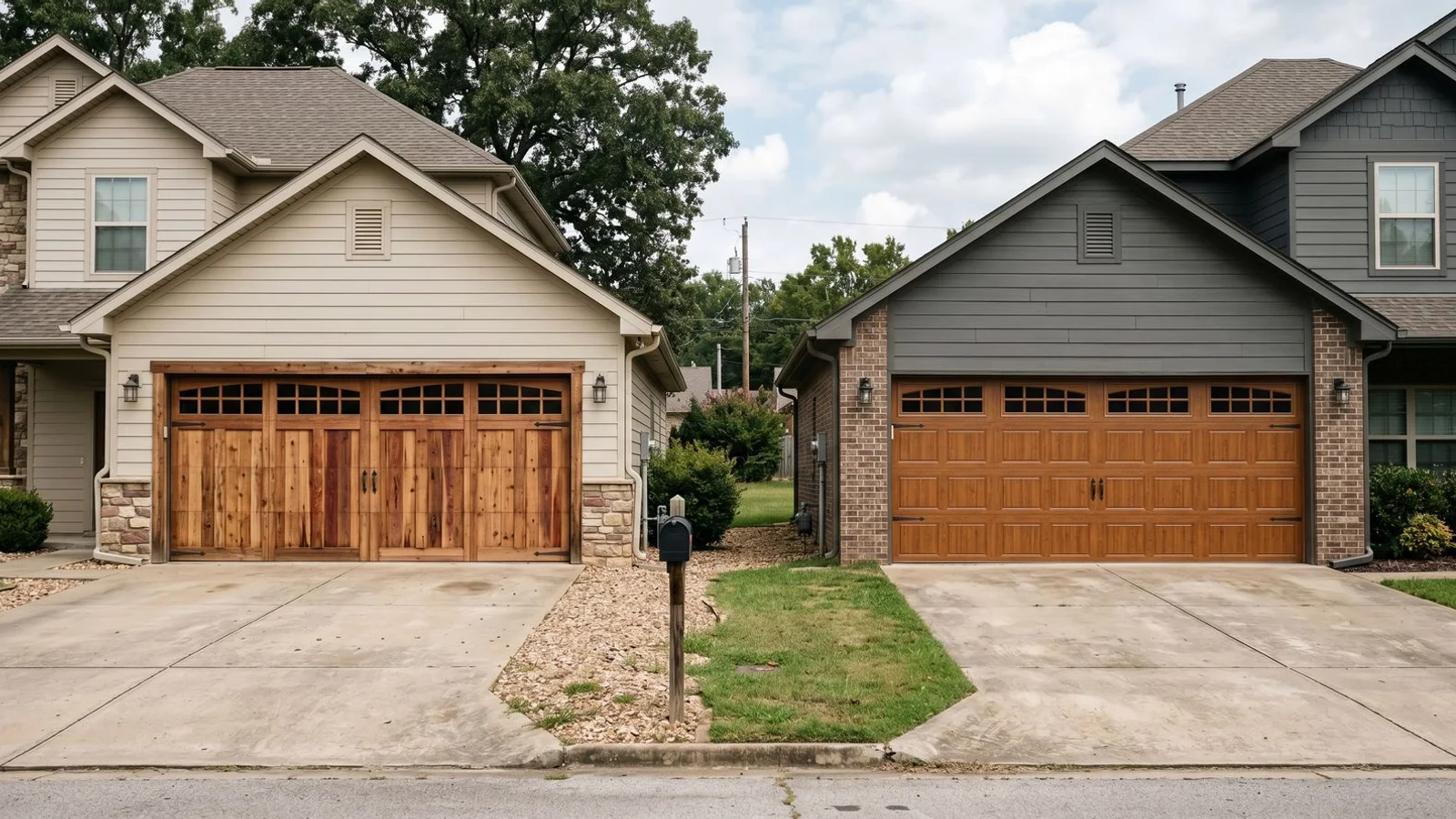
We often see homeowners weighing composite vs wood garage doors for their Northwest Arkansas property. The decision usually comes down to finding that perfect balance between curb appeal and long-term upkeep. Recent 2025 data actually shows a stunning 268% average return on investment for garage door replacements.
That high ROI makes your faux wood vs real wood door decision even more critical for your property value.
Our local installation team knows that the upfront price tag is only half the story. Let’s look at the data, break down the exact costs over time, and help you find the best fit for your specific driveway.
Side-by-Side Comparison: Composite vs Wood Garage Doors
Composite overlays provide superior durability and lower long-term costs, while real wood offers authentic textures at a premium price. Comparing these materials directly reveals a few stark contrasts. The table below outlines the core differences you will encounter with each option.
| Factor | Composite Overlay | Real Wood |
|---|---|---|
| Installed cost | $2,800 to $6,500 (e.g., Clopay Canyon Ridge) | $4,500 to $9,000+ (e.g., Custom Cedar) |
| Lifespan in NWA | 20 to 30 years | 10 to 20 years (with refinishing) |
| Maintenance | Cleaning only | Refinish every 3 to 5 years |
| Humidity resistance | Excellent | Poor in Arkansas (70%+ summer average) |
| Insulation | R-12 to R-20.4 | R-2 to R-8 |
| Weight | Moderate | Heavy |
| Aesthetic authenticity | Very close from street; obvious up close | Authentic |
| Repairability | Easy single-panel | Hard (custom panels, color matching) |
| Warranty | 10 to 20 years overlay | 5 to 15 years (with maintenance requirements) |
Cost Math Over a 15-Year Window
Over 15 years, a composite door costs around $5,100 total, whereas a real wood door will cost you upwards of $11,100 due to recurring maintenance. The true price tag of a garage door includes a decade or more of maintenance and repairs. We always encourage buyers to look at a 15-year ownership window to understand the full financial commitment. Natural timber requires a professional refinishing every few years to survive the local climate. Recent 2025 estimates show local painters charging between $500 and $800 to sand and restain a standard two-car wood garage door. Our composite overlay comparison math below highlights how these recurring fees add up.
Composite overlay:
- Initial cost: $4,500 (mid-range custom carriage style like CHI Overhead Doors)
- Maintenance over 15 years: $300 to $600 (occasional cleaning supplies, annual tune-up)
- Total 15-year cost: ~$5,100
Real wood:
- Initial cost: $7,500 (mid-range custom carriage style using cedar or mahogany)
- Refinishing 3 times in 15 years at $800 each: $2,400
- Possible panel replacement at year 10: $1,200
- Total 15-year cost: ~$11,100
Composite materials save you roughly $5,000 to $6,000 over a 15-year period. That remaining budget easily covers a major landscaping project or a family vacation.
Aesthetic Authenticity Discussion
Can people tell a synthetic surface is not actual timber? From the street, the answer is a definitive no, but up close under five feet, the difference becomes visible. Our team regularly installs both types, and the visual gap is much smaller than it used to be. Top manufacturers now mold their composite overlays from actual wooden boards. This exact process captures the natural grain of species like Clear Cypress and Mahogany with stunning accuracy.
- From the street (25+ feet): No one can tell the difference. The wood-grain texture, stained color, and panel detailing read as a premium product. Drivers passing the house see a stunning architectural feature.
- From the driveway (10 to 15 feet): Most casual observers cannot tell. A few detail-oriented guests might notice if they are specifically looking for it.
- Up close (under 5 feet): Yes, the difference becomes visible in most cases. The grain texture is convincing but slightly more uniform than natural timber. The stain color also lacks the unpredictable variation found in nature.
- At hand: The polymer feel is physically different from touching an organic material. Knocking on the surface produces a different sound. People who handle the door daily will learn the difference very quickly.
For most Northwest Arkansas buyers, the curb appeal from the street and driveway is the visual that matters most. We know that this distance drives the resale impression and your daily drive-up experience. Composite delivers that exact aesthetic authentically.
Why Composite Wins in Arkansas
Composite wins because it completely resists the destructive 70-percent average summer humidity that causes natural wood to warp and rot in Northwest Arkansas. The local climate is the deciding factor for a majority of local homeowners. We experience intense summer-to-winter cycles in cities like Fayetteville and Bentonville. Real wood absorbs this moisture and requires active, consistent maintenance to survive. Composite surfaces completely ignore these environmental swings.
“Faux wood materials will not rot, warp, or crack when exposed to heavy moisture. This makes a massive difference when you want an insulated steel core protected by a weatherproof exterior.”
If you genuinely enjoy maintaining your home with specialized treatments, natural timber remains a fine choice. Refinishing and restaining periodic wear is a rewarding hobby for some property owners. If you would rather have the visual warmth without the ongoing time investment, composite provides the exact right answer. Our customers overwhelmingly prefer spending their weekends relaxing rather than sanding exterior trim.
When Real Wood Still Makes Sense
Real wood remains the best choice for historically protected homes and specialized architectural designs that require organic materials. Natural timber is not obsolete by any means. We still install these premium products for clients with specific property requirements. A few scenarios exist where paying the premium is completely justified.
- Historic home restoration: Original construction materials are often a strict requirement for homes in designated historic districts.
- Specific architectural style: Some custom builds demand the unpredictable, natural variation of organic grain patterns.
- Covered garage exposure: Deep porch overhangs protect the surface from direct rain and extreme humidity swings.
- Homeowner enjoys the maintenance: Some people truly enjoy the hands-on hobby of conditioning and treating natural materials.
Real wood is highly appropriate for these specific, protected use cases. For everyone else in the region, synthetic options deliver the desired look at a substantially lower lifetime cost.
Long-Term Cost of Ownership
Composite doors cost essentially nothing to maintain beyond annual tune-ups, whereas real wood drains your budget through constant refinishing and heavier strain on motor parts. Real wood represents the higher-touch option financially and physically. We see heavy timber doors placing significant strain on your torsion springs and opening motors. A custom cedar setup can weigh hundreds of pounds, meaning your mechanical parts will wear out much faster than average.
Panel replacement on aged organic doors is extremely expensive because the sections are custom-sized and require fresh staining to match the faded surrounding pieces. Refinishing is messy, time-consuming, and requires either skilled DIY experience or a professional painter.
Composite ownership creates essentially zero ongoing financial drain beyond standard annual tune-ups. You treat the synthetic surface the exact same way you treat any standard steel option.
Our service logs show that faux materials simply outlast organic options in an exposed driveway environment. This extreme durability is a primary reason why modern replacements yield such a massive return on investment when you eventually sell the property.
The Honest Recommendation
For local buyers wanting a beautiful carriage-house design, comparing composite vs wood garage doors usually results in a clear winner for the synthetic option in 95% of cases. We find that the cost savings, lifespan advantage, and maintenance reduction make the decision incredibly clear. Homeowners usually make up their minds the moment they see both options sitting side-by-side.
See our composite overlay door page for full installation details. We always bring physical material samples directly to your driveway during a consultation.
Call (479) 469-8829 to schedule a time to compare the textures and colors in person.
Frequently Asked Questions
Can people tell composite isn't real wood?
From the street, no. Up close, premium composite gets very near to real wood — and the durability gap closes the decision for most NWA buyers.
Is composite cheaper than real wood?
Yes — significantly. Composite gives you the wood look at 40 to 60% of premium real wood cost, with much less maintenance over the door's life.
Does composite have the same insulation as wood?
Composite typically has better insulation because of the polyurethane steel core underneath the overlay. Real wood doors are typically lower R-value.