Garage Door Guide
Uneven, Sagging, or Crooked Garage Door? Here's What's Happening
An uneven or sagging garage door is almost always a spring, cable, or panel issue. Diagnose causes and the safe next step in Fayetteville.
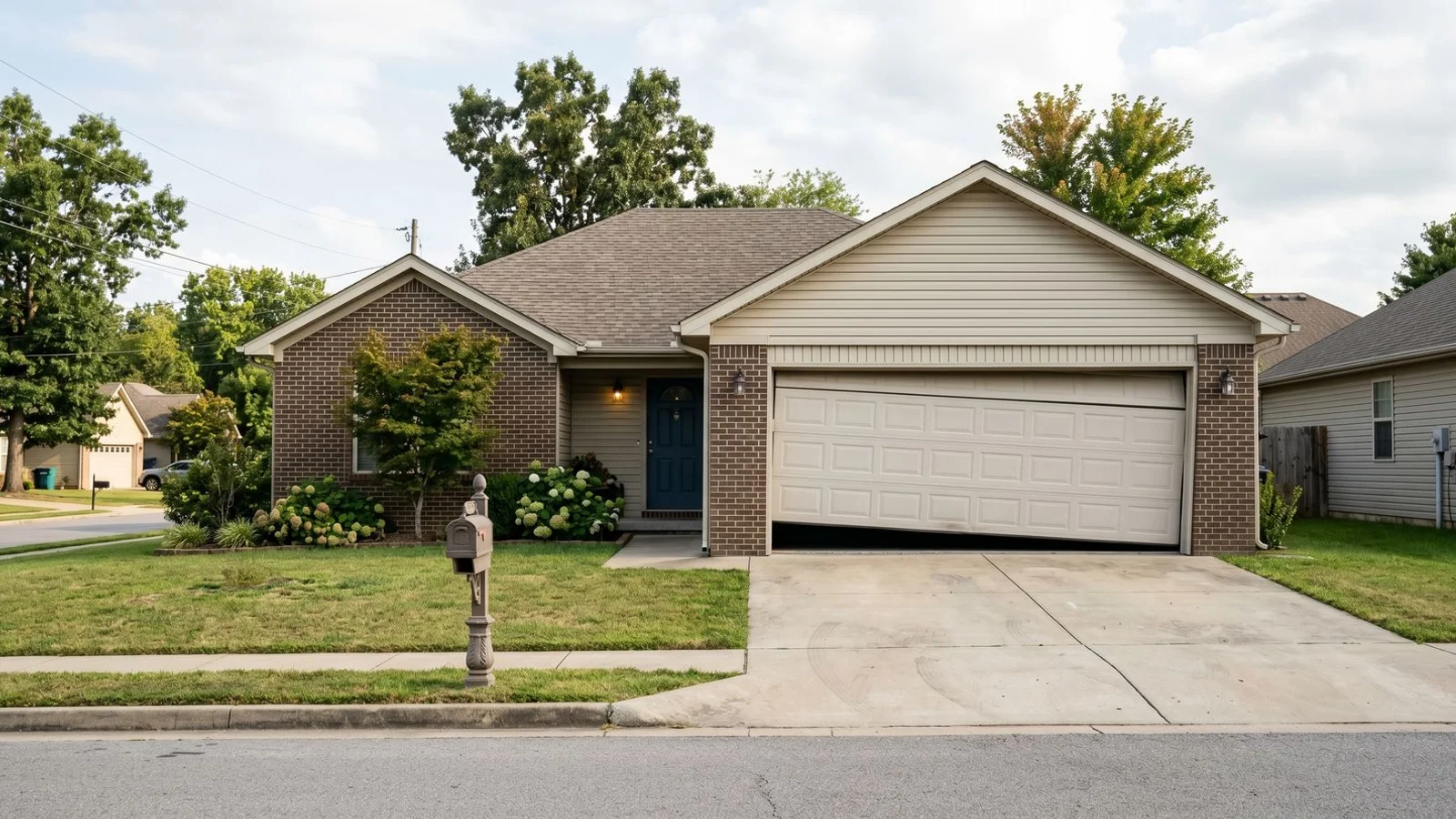
Any experienced technician will tell you that a garage door sagging crooked is more than just an eyesore. A tilted panel is a clear indicator that a critical structural component has completely failed. Operating the system in this condition will only create a more expensive repair bill.
Our team at Garage Doors of Fayetteville responds to these exact structural calls across Northwest Arkansas every week. The issue typically boils down to a snapped lifting cable, a broken extension spring, or severe panel damage.
We will break down the mechanics behind these common hardware failures. Let’s look at the data, what it is actually telling us, and then explore a few practical ways to respond safely.
One Side Hanging Lower Than the Other
Stand directly in front of the door and check if one bottom corner rests lower than the other. We find that a garage door uneven on one side points directly to a broken extension spring or a snapped lifting cable. A modern double-car steel door, like the popular Clopay Classic series, easily weighs between 150 and 200 pounds.
Our technicians always recommend replacing extension springs in pairs to maintain perfect balance. Standard extension springs are rated for about 10,000 cycles, which translates to roughly seven to ten years of use for an average US family. Forcing the system to lift that dead weight will strip the opener gears or snap the remaining intact cables.
Common Causes for an Uneven Hang
Here are the two main hardware failures responsible for a dropped side:
- Broken extension spring: These springs run along the upper horizontal tracks. The side with the snapped spring will drop immediately.
- Failed lifting cable: Torsion-spring systems rely on cables to hoist the heavy panels. A rusted or frayed cable will eventually snap under the tension.
We always urge you to review our detailed guide on spring repair for a deeper look at the replacement process. The safest move is to unplug the opener and leave the heavy lifting to professionals.
Gap Under the Door Across the Bottom
A visible gap under garage door panels usually indicates a failed weather seal or foundation settling. We constantly see how this specific issue lets cold air, rainwater, and local pests straight into your home. The US Department of Energy reports that drafts from exterior doors and attached garages can account for 5 to 30 percent of a home’s total energy loss.
Our team fixes this drafty problem by installing heavy-duty replacements. A standard rubber strip will crack and harden after a few years of harsh weather. We prefer to install a high-quality 5/16-inch T-style astragal or a Wayne Dalton bead bottom seal to ensure a tight fit.
Comparing Bottom Seal Solutions
| Seal Type | Best Application | Average Lifespan |
|---|---|---|
| Standard Vinyl | Mild climates, flat concrete | 3 to 5 years |
| Heavy-Duty T-Style Astragal | Extreme temperature shifts | 7 to 10 years |
| Rubber Threshold Seal | Settling or uneven foundations | 5 to 8 years |
These premium seals cost between $40 and $80, but the upgrade easily pays for itself in lower heating bills. You should inspect the garage floor closely. Foundation settling can leave the concrete uneven beneath the panels.
We recommend using a thicker threshold seal if the concrete floor has shifted significantly. A deformed bottom steel panel can also cause a gap, which requires a complete section replacement.
Door Sagging in the Middle
A sectional door that bows in the middle when partially open is showing clear signs of strut fatigue. We often find that the horizontal braces reinforcing the panels have weakened from age or repeated impact. Double-car doors spanning 16 feet are especially prone to this central sag if they were installed without proper reinforcement.
Our standard fix involves installing heavy-duty reinforcement struts across the affected sections. The best practice is to use 22-gauge galvanized steel struts measuring 2-1/4 inches wide. We source these thick steel struts because they increase the structural integrity of the panel by up to 20 percent.
Adding a stronger horizontal brace is a highly cost-effective alternative to buying a brand new door. We generally complete a strut reinforcement for $150 to $300, saving homeowners a massive replacement bill. Attempting to bend the panel back into shape without a steel strut will only weaken the metal further.
Warning Signs of Strut Fatigue
Pay close attention to these indicators before the panel cracks completely:
- The half-open test: The center of the door bows downward when paused halfway up the track.
- Creaking noises: The metal panels groan or pop loudly during operation.
- Visible creases: Small hairline cracks or bends appear along the center exterior of the steel panels.
Crooked Door That Won’t Sit Square in the Opening
If the entire crooked garage door looks tilted inside the frame, you are dealing with a track alignment issue or jumped rollers. We urge you to stop using the system immediately to prevent permanent damage to the hinges. Forcing a jammed door up or down will inevitably bend the vertical rails.
Common Causes of a Tilted Door
- Off-track rollers: One or more wheels have jumped completely out of the guiding rail.
- Bent vertical tracks: A car bumped the rail, causing the path to twist.
- Out-of-square framing: The wooden frame of the garage has shifted due to foundation movement.
Our service calls frequently reveal that cheap plastic rollers have simply popped out of the vertical track. Upgrading to high-quality hardware, like DURA-LIFT Ultra-Quiet 2-inch nylon rollers equipped with 13-ball bearings, provides a much smoother and safer operation. We strongly advise using nylon rollers because they eliminate the harsh metal-on-metal scraping sounds.
A crooked hang can also result from a bent track caused by a vehicle impact or a severe storm. We fix off-track and bent-track issues securely through our panel and track repair service. A standard track realignment runs between $200 and $400.
Major structural shifting can occasionally create an out-of-square opening. We see this rarely, but it requires adjusting the frame before any hardware can operate correctly. Never try to hammer a bent track back into shape yourself, as a misaligned track will cause the door to crash.
Safety: Stop Using the Door
The absolute most important rule for a garage door sagging crooked or hanging out of balance is to cut the power to the opener. We see too many homeowners risk a complete failure by ignoring early warning signs. A compromised system places an unpredictable load on the motor and the intact springs.
Our data shows that the very next cycle could be the one that triggers a sudden, dangerous drop. You will be glad to know that these repairs are usually much faster and cheaper than expected. Here is a short list of common pricing for these fixes.
Average Repair Estimates
- Broken Springs: $300 to $500
- Snapped Cables: $300 to $500
- Damaged Panels: $300 to $800
- Track Realignment: $200 to $400
We will always give you a straight, honest answer if your specific situation actually requires a full replacement. Fixing an out-of-balance door promptly is the smartest way to protect your investment.
Call (479) 469-8829 for quick diagnostics and same-day support. We proudly serve homeowners across Fayetteville, Springdale, Rogers, Bentonville, and the rest of Northwest Arkansas.
Frequently Asked Questions
Why is one side of my garage door lower than the other?
Usually a broken extension spring or a snapped cable on the low side. Both are dangerous and require professional repair — the door is out of balance and can fall.
Is it safe to use a sagging garage door?
No. A door that's out of balance can drop suddenly during operation. Stop using it until a tech inspects the springs and cables.
Can a sagging door be repaired or does it need full replacement?
In most cases just the broken spring, cable, or single damaged panel needs replacement. A full new door is rare — we only recommend it when multiple panels are damaged or the door is at end-of-life.