Garage Door Guide
Garage Door Won't Open or Close? Start Here.
Step-by-step checks for a garage door that won't open or close in Fayetteville. Quick safety guidance and when to call a Northwest Arkansas tech.
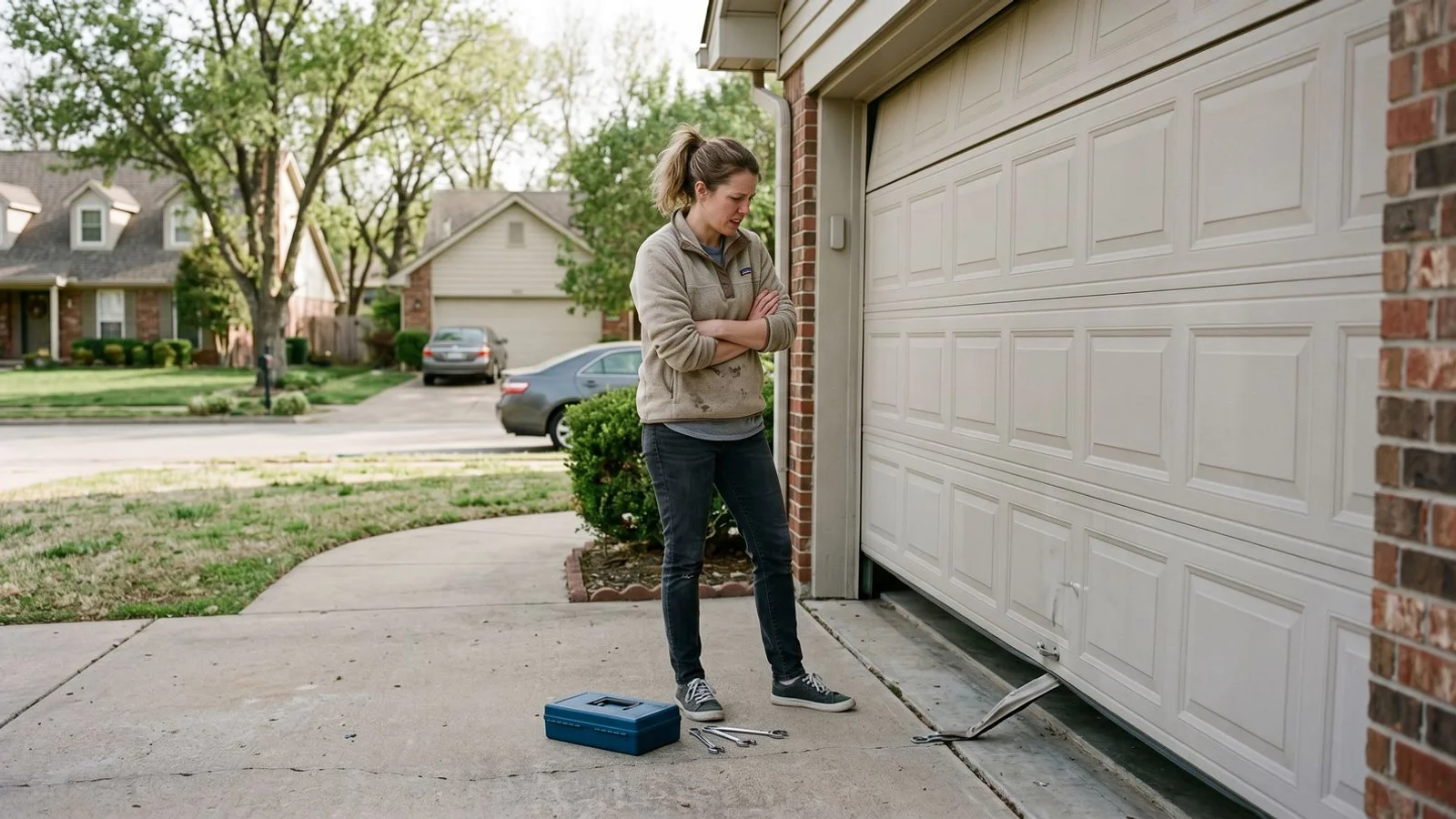
We see this all the time across Northwest Arkansas: a stuck garage door completely disrupts your morning routine.
A garage door stuck in its tracks is incredibly frustrating.
Our team at Garage Doors of Fayetteville has diagnosed thousands of these exact situations.
The good news is that you can resolve nearly half of these issues yourself in under five minutes. The other half usually involve a structural failure requiring professional tools.
Let’s look at a practical triage walkthrough you can use right now to identify the problem safely.
Safety First: Stop and Look
Stop pressing the wall button immediately and visually inspect the door’s hardware.
You need to verify the structural integrity before attempting any movement.
Our technicians always look for a visible gap in the torsion spring coil directly above the door. A loud bang from your garage overnight is the classic warning sign of a snapped spring.
Look closely for these specific warning signs:
- Uneven resting position: One side hangs lower than the other.
- Visible spring gaps: A two-inch separation in the tight metal coils above the door.
- Loose cables: Slacked or frayed wires on the side drums.
We highly advise against forcing the door if you spot these red flags.
A standard residential double door weighs upwards of 200 pounds.
Without a functioning spring, that entire load shifts directly onto your opener motor. Forcing operation can strip the motor gears or cause a catastrophic free-fall.
Check the Safety Sensors First
If your garage door wont close, misaligned or blocked safety sensors are the primary suspects. These small photo-eye units sit at the bottom of each vertical track to prevent accidents.
Federal law under UL 325 requires these infrared beams to function perfectly before the motor engages.
Our experts find that a simple 60-second inspection usually solves this specific issue.
Look at the small LED lights on both sensor units. The sending sensor typically displays a steady yellow or amber light. The receiving unit across the opening must show a solid green light.
A blinking, red, or dark LED means the safety circuit is broken.
Try these quick sensor fixes:
- Clear the path: Remove stray leaves, cobwebs, or trash cans blocking the invisible beam.
- Clean the lenses: Wipe the glass eye with a soft, dry microfiber cloth.
- Adjust alignment: Gently nudge the metal bracket until both LED lights stay solid.
- Check for sun glare: Late afternoon sunlight can sometimes blind the receiving sensor.
We recommend placing a small piece of cardboard over the sensor to block direct sunlight if glare is the culprit. If both lights are solid and the door still reverses, you might have faulty wiring.
Check the Power and Remote
Start by verifying power at the main electrical panel if your opener remote not working or the wall console is completely dead. A tripped breaker is a surprisingly common culprit.
Our repair crews also regularly find openers simply unplugged from the ceiling outlet.
You should also check your wall console for a sliding vacation or lockout switch. This physical switch intentionally disables all remote signals for security.
A dead lithium coin battery is the most frequent cause of remote failure. Replacing the standard CR2032 battery fixes the problem in minutes.
Here is a quick checklist for power and signal issues:
- Swap the battery: Test the remote with a fresh 3-volt battery.
- Check for interference: Cheap LED bulbs in the garage can emit signals that block your remote frequency.
- Reprogram the remote: Press the colored Learn button on the ceiling motor unit to pair the device again.
We suggest referring to your specific manufacturer manual for the exact reprogramming sequence. Brands like LiftMaster and Chamberlain use specific button colors to indicate their radio frequency.
Try the Manual Release Cord
Pull the red emergency release cord hanging from the ceiling rail to operate your door manually. This action disconnects the trolley carriage from the motorized belt or chain.
Our safety protocols require the door to be in the fully closed position before you pull this cord. Pulling the release on an open door with a broken spring will cause it to crash down violently.
Gently lift the door by the bottom handle once you disengage the motor. The door should glide up smoothly and feel relatively light.
You have isolated the problem to the electronic opener if it opens easily. A door that feels as heavy as a refrigerator indicates a severe spring failure.
You should never try to manually lift a door lacking spring tension.
To re-engage the system later, follow these steps:
- Pull the red cord straight down.
- Pull it backward in the direction of the motor unit.
- Press your wall button to cycle the opener once.
The carriage will automatically snap back into place along the rail.
When to Call a Professional
Call a certified technician immediately if the door feels impossibly heavy or exhibits visible structural damage. Operating a compromised door puts your safety and your property at serious risk.
Our field teams consider broken torsion springs and snapped lift cables to be high-priority emergencies.
Contact us for professional repair if you notice any of these warning signs:
- Imbalanced lifting: The door is extremely heavy or one side hangs visibly lower.
- Loud mechanical noises: You hear intense grinding from the ceiling motor unit.
- Sudden loud impacts: A sharp metallic bang echoed through the house recently.
- Track misalignment: The metal rollers have popped out of the vertical tracks completely.
- Aging equipment: The opener is over a decade old and fails randomly.
We categorize these issues as complex mechanical failures requiring specialized tools.
For broken springs, see our broken spring repair page. For dead or failing openers, see our opener repair service. For off-track or bent-panel doors, see our panel and track repair page.
What Most NWA Calls Look Like
Broken torsion springs account for roughly 40% of the emergency service calls we receive across Northwest Arkansas. Homeowners often hear a startling bang from the garage but fail to connect it to the heavy door.
Our service logs show that opener electrical faults make up another 25% of local repair visits. Simple sensor misalignments cause about 20% of the issues we see.
You can usually fix those photo-eye problems yourself in just a few seconds. The final 15% consists of severe structural damage like bent panels and snapped cables.
Call (479) 469-8829 if these quick triage steps failed to solve your problem. We will happily walk you through further troubleshooting over the phone.
Our dispatchers can send a fully stocked truck directly to your home. Fast, reliable same-day service is available across Fayetteville, Springdale, Rogers, Bentonville, and the surrounding areas.
Frequently Asked Questions
Should I keep trying to open my garage door if it's stuck?
No. If the door is unusually heavy or you heard a loud bang earlier, the spring is likely broken and forcing the door can damage the opener and injure you. Stop and call for repair.
Why does the door start to close then go back up?
Almost always misaligned or blocked safety sensors. Check the LEDs on both sensors — solid green on both usually means alignment is fine. If one is blinking or red, gently adjust until both turn solid green.
Can I manually open my garage door?
Yes if the spring is intact — pull the red emergency release cord hanging from the opener. If the door feels extremely heavy when you try to lift it, stop. A broken spring means the door is unsafe to operate manually.