Broken Garage Door Spring Repair
Torsion Springs vs Extension Springs Explained
Visually identify torsion vs extension garage door springs, learn their lifespan, and understand why most Arkansas homes use torsion.
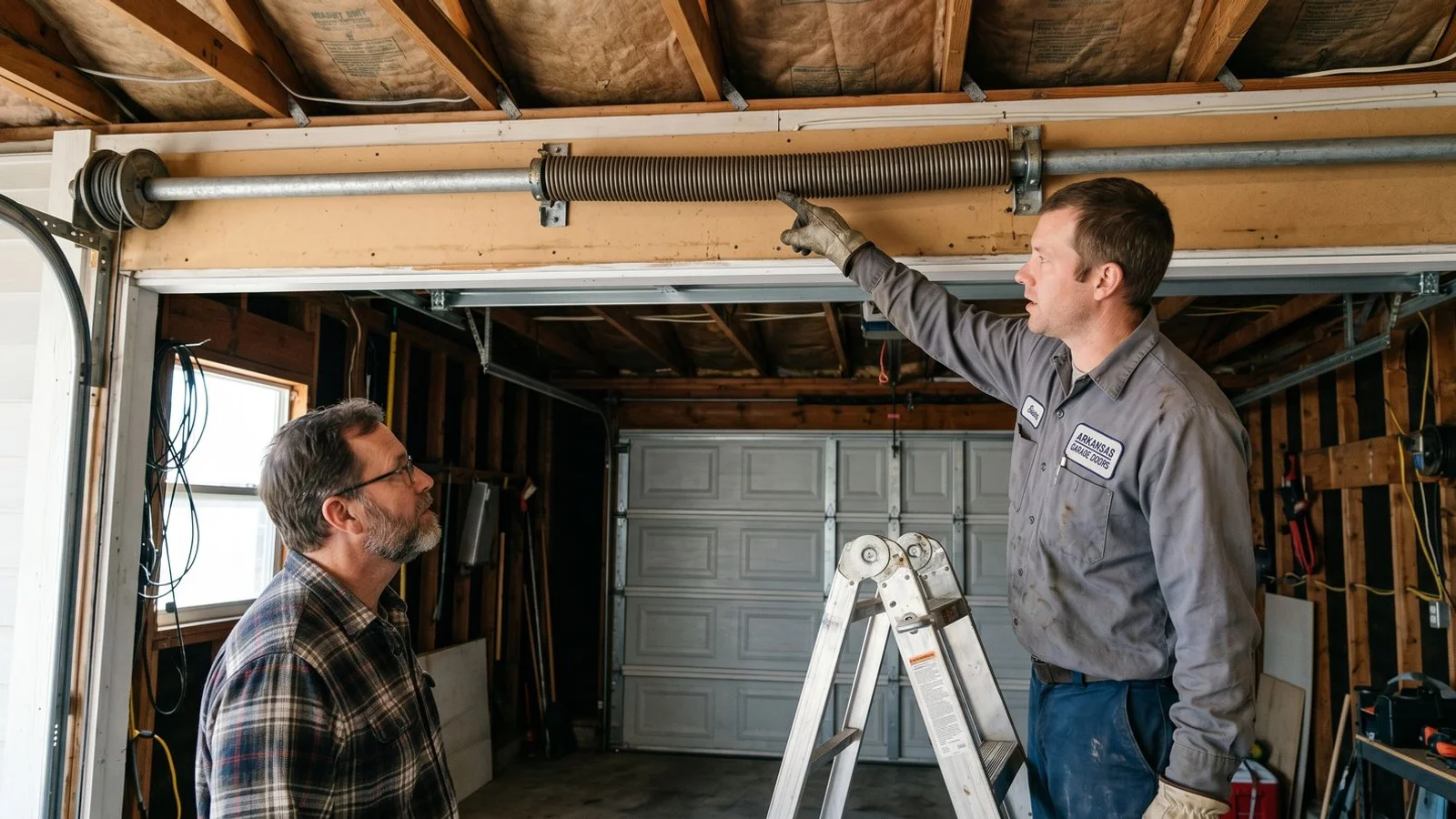
Most local homeowners rarely think about their garage door spring types until an unexpected snap leaves their car trapped on a busy Monday morning.
At Garage Doors of Fayetteville, we consider spring identification to be the most important factor in predicting a hardware failure before it happens. The physical differences between the two systems dictate entirely different performance expectations.
Let’s walk through the practical lifespan data and the safety factors that should drive your next upgrade decision.
Visual Identification
You can quickly identify your garage door spring type by simply looking at its location and shape. Torsion springs sit directly above the closed door on a horizontal metal tube, while extension springs stretch along the upper horizontal tracks on either side of the garage ceiling.
We train our technicians to look for a few specific details right away. The color-coding on the metal provides a massive amount of valuable information. The Door & Access Systems Manufacturers Association (DASMA) uses a standardized paint system to identify specific replacement parts.
- Torsion spring identification: Look directly above the closed door for a heavy horizontal shaft called a torsion tube. You will spot one or two tightly coiled springs mounted over this tube. High-quality torsion springs feature a splash of paint on the cones that indicates the exact wire gauge. You will also see lifting cables running from the drums at each end of the shaft down along the vertical tracks.
- Extension spring identification: Look up at the horizontal tracks running parallel to your garage ceiling. You will see a long, thin spring stretched out alongside each track. A standard setup features one spring per side. Extension springs use DASMA color codes on the ends to indicate their weight capacity, with colors repeating for different weight classes. A proper installation will always include a safety cable running through the center of the coils.
Reading the Spring Hardware
Spotting the physical differences is just the first step. You should also check the overall condition of the metal and the attached hardware. Rust buildup on either spring style is a clear warning sign of impending failure. Torsion systems tend to hide their wear slightly better, while extension coils will visibly gap and sag as they lose tension.
How They Work
Torsion and extension springs perform the identical job of counterbalancing the heavy weight of the door, but they generate force in completely opposite ways. Torsion springs store mechanical energy by twisting, whereas extension systems build tension by stretching out.
We see the mechanical differences clearly when operating doors manually. An average double-car garage door weighs between 150 and 300 pounds. The spring system must offset this massive load so the electric opener can lift the panels with minimal effort.
Mechanical Action Breakdown
Torsion springs generate lifting power through torque. When the door closes, the coiled spring winds tighter and stores rotational energy. When you open the door, the spring unwinds to turn the shaft, which winds the cables onto drums and pulls the door upward.
Extension springs rely entirely on linear force. Closing the door stretches the springs forcefully along the ceiling tracks. Opening the door allows the stretched coils to violently contract, which pulls on a system of pulleys and cables to heave the panels off the floor.
| System Characteristic | Torsion Springs | Extension Springs |
|---|---|---|
| Force Generation | Twisting motion (torque) | Stretching motion (linear tension) |
| Location | Header wall above the door | Ceiling alongside horizontal tracks |
| Energy Release | Contained on the mounting shaft | Pulls along an open track |
Lifespan
Both garage door spring types are rated by a cycle count, where one complete open and close sequence equals a single cycle. Standard torsion and standard extension springs both carry a baseline rating of 10,000 cycles, but their real-world aging processes look very different.
We calculate lifespan based on daily usage habits. A typical Northwest Arkansas family opens and closes their garage about four times a day. This math means a standard 10,000-cycle part will reliably last for roughly seven years before metal fatigue causes a break.
Cycle Rating Comparisons
- Standard torsion: 10,000 cycles (about 7 years of average use)
- High-cycle torsion: 25,000 cycles (about 15 to 20 years of use)
- Standard extension: 10,000 cycles (around 7 years, but prone to early sagging)
- High-cycle extension: 25,000 cycles (extended life, though pulley wear remains a factor)
While the raw cycle ratings match on paper, torsion springs consistently outlast their extension counterparts in the field. Torsion coils operate with a smooth rotational motion that distributes stress evenly.
Extension systems must endure constant extreme stretching, which aggressively accelerates wear on the coils, the cables, and the attached pulleys. Recent 2026 industry tracking shows a sharp rise in premature extension spring failures as homeowners use their garages more frequently as primary entrances.
Safety Differences
Torsion systems are significantly safer than extension systems because they contain their stored energy on a sturdy metal shaft. If an extension spring snaps without a safety cable installed, the metal coil can whip across the garage with enough force to cause severe injury or property damage.
Our technicians treat every spring repair with extreme caution. The Consumer Product Safety Commission (CPSC) notes that over 1,600 injuries occur annually in the United States due to garage door maintenance and repair accidents. High-tension metal coils are inherently dangerous to handle without specialized winding bars and professional training.
Safety Standards to Check
The potential for injury makes proper safety hardware non-negotiable. Modern safety regulations address the exact failure points of these heavy components.
- Torsion containment: Torsion springs rarely pose a projectile risk. When the steel finally gives out, the broken coil simply remains trapped on the central horizontal shaft. It creates a loud bang, but the pieces stay securely in place.
- Extension whip hazards: Extension systems spread their extreme tension along two open tracks. DASMA and UL 325 safety standards explicitly require a steel safety cable routed through the middle of every extension spring. This cable catches the metal if the coil shatters.
- Older home risks: Many older homes still operate on original extension setups that predate the safety cable mandate. Operating an older extension system without these safety cables is a massive hazard that requires immediate correction.
Why Most Modern NWA Homes Use Torsion
Almost all new garage doors installed across Northwest Arkansas since the late 1990s rely exclusively on torsion spring systems. Builders and homeowners prefer the torsion design because it provides a noticeably smoother operation and safely supports the heavy weight of modern garage door materials.
We install torsion systems on nearly every new build in the area today. The local architecture trends heavily favor thick steel panels and heavy composite overlays.
The Shift To Heavy Doors
Current 2026 building trends in the Fayetteville and Bentonville areas prioritize high-efficiency, insulated doors. These dense, foam-filled panels provide excellent climate control but add significant weight. A heavy door demands the balanced lifting power that only a torsion setup can deliver reliably.
Key Reasons for the Torsion Preference
- Smoother daily operation: Torsion setups deliver an even, controlled lift that reduces strain on the electric opener motor.
- Proven longevity: The twisting motion creates less metal fatigue, which translates to fewer service calls over the lifespan of the door.
- Superior safety: A broken torsion spring stays locked on the header shaft instead of flying across the room.
- Better weight management: Torsion is the only practical choice for the heavy insulated panels that are now standard in local home construction.
Older near-campus housing in Fayetteville and 1970s constructions across Washington County still feature a large number of original extension spring systems. Our team services both formats regularly, and we routinely upgrade these older properties to torsion mechanics during major repair appointments.
When to Convert from Extension to Torsion
You should strongly consider a torsion conversion if your existing extension springs break and you are already paying a technician for a service visit. Upgrading your hardware replaces the outdated stretching mechanics with a safer, smoother, and longer-lasting rotational system.
We advise homeowners that the financial jump to a better system is surprisingly small. The incremental cost for a conversion kit is typically just $150 to $300 over the price of a basic extension spring replacement. This modest investment brings your home up to modern safety standards and drastically reduces the wear and tear on your automatic opener.
Taking the Next Step
If you live in an older home and hear grinding noises or notice the door hanging unevenly, the spring system is likely failing. Replacing the parts before they snap completely saves you from an emergency lockout situation.
Call (479) 469-8829 for a free spring assessment from our local team. You can visit our spring repair page to review our specific service details. We also encourage you to explore the different cycle rating options to help you make an informed decision on your upcoming upgrade.
Frequently Asked Questions
Which type of spring is on my garage door?
Look above the door header. A long coiled spring across a horizontal shaft = torsion. Two springs running along the upper horizontal tracks = extension.
Is one type better than the other?
Torsion is safer, smoother, and lasts longer. Extension is cheaper to install but harder to balance and slightly more dangerous if it fails.
Can I convert from extension to torsion?
Yes in most cases. We do this conversion regularly for older NWA homes — the upgrade pays back in smoother operation and longer life.